



Peptide-Drug Conjugates (PDCs)
Peptide-Drug Conjugates (PDCs)
Peptide-drug conjugates (PDCs) are the next generation of targeted therapeutics drug after antibody-drug conjugate (ADCs) and hold broad prospects in fields such as tumor treatment. PDCs combine peptides selectivity with chemotherapeutic drugs lethality, with the core benefits of enhanced cellular permeability and improved drug selectivity. PDCs consist of three important components: peptides, linkers and cytotoxic payloads. Among them, peptides mainly include homing peptides and cell-penetrating peptides, which can affect the efficiency of drug endocytosis. The ideal peptide should have high affinity, stability, and so on. Cytotoxins is the key to killing tumor cells and has both therapeutic and imaging functions. Cytotoxins for coupling have four requirements as followed: a clear mechanism of action, a small molecular weight, high cytotoxicity and retained anti-tumor activity after chemical coupling to the peptide. The linker needs to connect the peptide and the cytotoxic payload and can be divided into cleavable and non-cleavable types. The choice of linker is crucial and requires consideration of the microenvironment in which the PDC is located to avoid interfering with the binding affinity of the peptide to its receptor and the drug efficacy. The linker must have a certain level of stability to prevent premature and nonspecific drug release[1].
-
Peptide-Drug Conjugates (PDCs) 関連製品 (28)
関連製品 (28)

- 1
- 2
-
ANG1005
 0 Images別名: GRN1005; Paclitaxel trevatideANG1005 (Paclitaxel trevatide) is a brain-penetrating peptide-drug conjugate. ANG1005, a taxane derivative, consists of three paclitaxel (HY-B0015) molecules covalently linked to Angiopep-2, designed to cross the blood-brain and blood-cerebrospinal barriers and to penetrate malignant cells via low density lipoprotein receptor-related protein (LRP1) transport system.
-
2-Octynoic acid-BSA
 0 Images製品番号: HY-1607192-Octynoic acid-BSA is an immunogen used to establish a mouse model of primary biliary cholangitis (PBC). When used in combination with Complete Freund's Adjuvant (HY-153808), 2-Octynoic acid-BSA stimulates the body's immune system, which recognizes it as a foreign antigen and triggers an immune response against autologous biliary epithelial cells. This leads to the production of anti-PDC-E2 antibodies, causing bile duct damage and inflammation. 2-Octynoic acid-BSA is promising for use in primary biliary cholangitis research.
-
L-gamma-Glutamyl-L-threonine
 0 ImagesL-gamma-Glutamyl-L-threonine (gamma-Glutamylthreonine; H-γ-Glu-Thr-OH; γ-Glu-Thr) is a dipeptide obtained through the formal condensation of the L-glutamic acid side chain carboxyl group and the L-threonine amino group. L-gamma-Glutamyl-L-threonine is present in high concentrations in human urine and exhibits antibacterial activity against Gram-negative bacterial. L-gamma-Glutamyl-L-threonine is also a flavor compound. Gamma-Glutamylthreonine is a metabolite catalyzed by γ-glutamyl transpeptidase and is associated with immune regulation. Gamma-Glutamylthreonine can be used in research on inflammation and bacterial infections.
-
DOTA-EB-TATE
 0 ImagesDOTA-EB-TATE is composed of SST peptide derivative, DOTA-octreotate conjugated a common to an Evans blue analog (EB). DOTA-EB-TATE is a peptide drug conjugate (PDC) improves the pharmacokinetics of SSTR2 analogs and reduces PRRT toxicity. DOTA-EB-TATE can also be used for the synthesis/research of Radionuclide-Drug Conjugates (RDCs).
-
Ricorfotide vedotin
 0 Images別名: CBP-1008; LDC 10BRicorfotide vedotin (CBP-1008) is a dual-ligand peptide-drug conjugate (PDC) conjugated to MMAE (HY-15162), targeting Folate receptor α (FRα) and TRPV6. Ricorfotide vedotin binds to FRα with high affinity and TRPV6 with low affinity. Ricorfotide vedotin has antitumor activity, and can be used in advanced solid tumor research (eg: colorectal cancer, breast cancer, non-small cell lung cancer, ovarian cancer, adrenocortical carcinoma and follicular dendritic cell sarcoma).
-
MC-GGFG-TriPtolide
 0 Images製品番号: HY-188016CAS 番号: 3086791-83-2MC-GGFG-TriPtolide is a peptide-drug conjugate (PDC) composed of a cell-penetrating peptide (MC), a cathepsin-cleavable GGFG peptide linker, and the payload drug Triptolide (HY-32735), and it is used for targeted intracellular delivery.
-
Ganipatide
 0 ImagesGanipatide is a 1-31-Glucose-dependent insulinotropic polypeptide. Ganipatide is promising for research of diabetes.
-
Zoptarelin doxorubicin
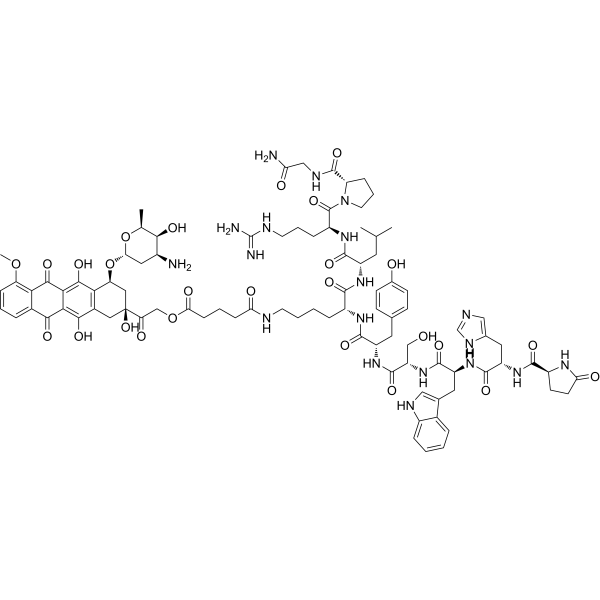 0 Images製品番号: HY-16532CAS 番号: 139570-93-7別名: AEZS-108; AN-152Zoptarelin doxorubicin (AEZS-108; AN-152) is a hybrid anticancer agent, containing Zoptarelin and Doxorubicin. Zoptarelin doxorubicin has been used to research targeting tumors expressing LHRH receptors. Zoptarelin doxorubicin abolishes tumor progression and induces remarkable apoptosis in vitro.
-
L2P4 TFA
 0 Images製品番号: HY-P10772A純度: 98.25%L2P4 TFA is a peptide-based and EBNA1 targeting fluorescent probe, which inhibits the EBNA1 homodimer formation and selectively inhibits EBV+ tumor growth. L2P4 TFA exhibits cytotoxicity in EBV-positive C666-1 cell with LC50 of 46.4 μM.
-
EB1 peptide
 0 Images別名: Penetrating analogEB1 peptide (Penetrating analog) is an endosomolytic agent and siRNA delivery agent. EB1 peptide forms an amphipathic alpha helix upon protonation in early-late endosomes, drives endosomal membrane permeabilization, and enables endocytosed siRNA escape into the cytosol. EB1 peptide facilitates biologically active siRNA cellular uptake and targeted gene silencing. EB1 peptide forms complexes with siRNA. EB1 peptide can be used for drug delivery research.
-
CBP-1018
 0 ImagesCBP-1018 is a PDC (peptide-drug conjugate) formed by conjugating Monomethyl auristatin E (HY-15162) to a dual-targeting ligand of FLOR1/PSMA (prostate-specific membrane antigen) via a linker (HY-78738). CBP-1018 binds to FLOR1 and prostate-specific membrane antigen (PSMA). CBP-1018 is applicable to the research of solid tumors and metastatic castration-resistant prostate cancer.
-
L 377202
 0 Images製品番号: HY-106195CAS 番号: 207395-85-5L 377202 is a peptide-drug conjugate (PDC). L 377202 consists of Doxorubicin (HY-15142A) and a prostate-specific antigen (PSA)-hydrolyzable peptide. L 377202 demonstrates strong inhibitory effects on PSA-secreting prostate cancer cells. L 377202 is promising for research of prostate cancer.
-
CTP-amiodarone
 0 Images製品番号: HY-P10773CTP-amiodarone is a cell-penetrating conjugate of cardiomyocyte targeting peptide and Amiodarone (HY-14187). CTP-amiodarone exhibits antiarrhythmic efficacy through block of Na+, K+, Ca2+ channels and β-adrenergic receptors.
-
PhAc-ALGP-Dox
 0 Images製品番号: HY-P10760CAS 番号: 1616592-31-4PhAc-ALGP-Dox, a peptide-drug conjugate, is a novel anticancer prodrug, with IC50 values ranged from 311 nM to 34.25 μM for TNBC (E0771), normal murine epithelium (HC-11), human TNBC (MDA-MB-231 and MDA-MB-468), human CrC (LS 174T), normal human epithelium (HME-1) cells.
-
BPP 5a
 0 Images製品番号: HY-P2619CAS 番号: 30505-63-6BPP 5a is a bradykinin-potentiating peptide with vasorelaxant activity, which is found in Bothrops jararaca venom. BPP 5a is an angiotensin-converting enzyme (ACE) inhibitor with a Ki value of 400 nM. BPP 5a is promising for research of hypertension and cardiovascular diseases.
-
Pep1-DNP conjugate 9
 0 Images製品番号: HY-P10870Pep1-DNP conjugate 9 is a functionalized peptide which is composed of the DNP-Hapten and the FGFR1 binding peptide. Pep1-DNP conjugate 9 exhibits good affinity to FGFR1 with KD of 5.01 μM. Pep1-DNP conjugate 9 recruits anti-DNP antibodies to the surface of FGFR1-positive cells, inhibits the FGF2-induced proliferation in rat skeletal myoblast cells, and induces apoptosis. Pep1-DNP conjugate 9 exhibits antitumor efficacy in mouse models.
-
DTS-201
 0 Images製品番号: HY-106154CAS 番号: 274912-87-7DTS-201 (CPI-0004) is a peptidic prodrug of Doxorubicin (HY-15142A). DTS-201, comprising the tetrapeptide portion, is cleaved by endopeptidases in the tumor environment to produce metabolites that subsequently enter the cell and are converted to active Doxorubicin. DTS-201 shows antitumoral efficacy in tumor xenograft models of prostate, breast, and lung cancer.
-
BT1769
 0 Images製品番号: HY-P10775BT1769 is a MT1-MMP-targeted (KD = 3.35 nM) Bicycle toxin conjugate. BT1769 can be used in the study for osteosarcoma. BT1769 consists of a novel bicyclic targeting peptide that selectively binds MT1-MMP; a cytotoxin MMAE; and an enzymatically cleavable dipeptide linker.
-
DDDEEKC
 0 Images製品番号: HY-P11204CAS 番号: 2097620-33-0DDDEEKC is a bioinspired peptide sequence that can selectively adsorb onto the enamel surface (mimicking the role of salivary acquired pellicle protein statherin), acting as a "target - guiding agent" for tooth enamel remineralization. DDDEEKC enhances the regeneration of hydroxyapatite (HAP). DDDEEKC is promising for research of in-situ remineralization repair of enamel demineralization damage (such as dental caries).
-
DTS-108
 0 Images製品番号: HY-P10765CAS 番号: 951792-83-9DTS-108 is a prodrug of SN38 (HY-13704) (a Topoisomerase I inhibitor). DTS-108 is a conjugate generated by linking SN38 to a human oligopeptide via an esterase sensitive cross-linker. DTS-108 exhibits anti-tumor activity against colorectal, lung, and mammary cancer.
- 1
- 2



